
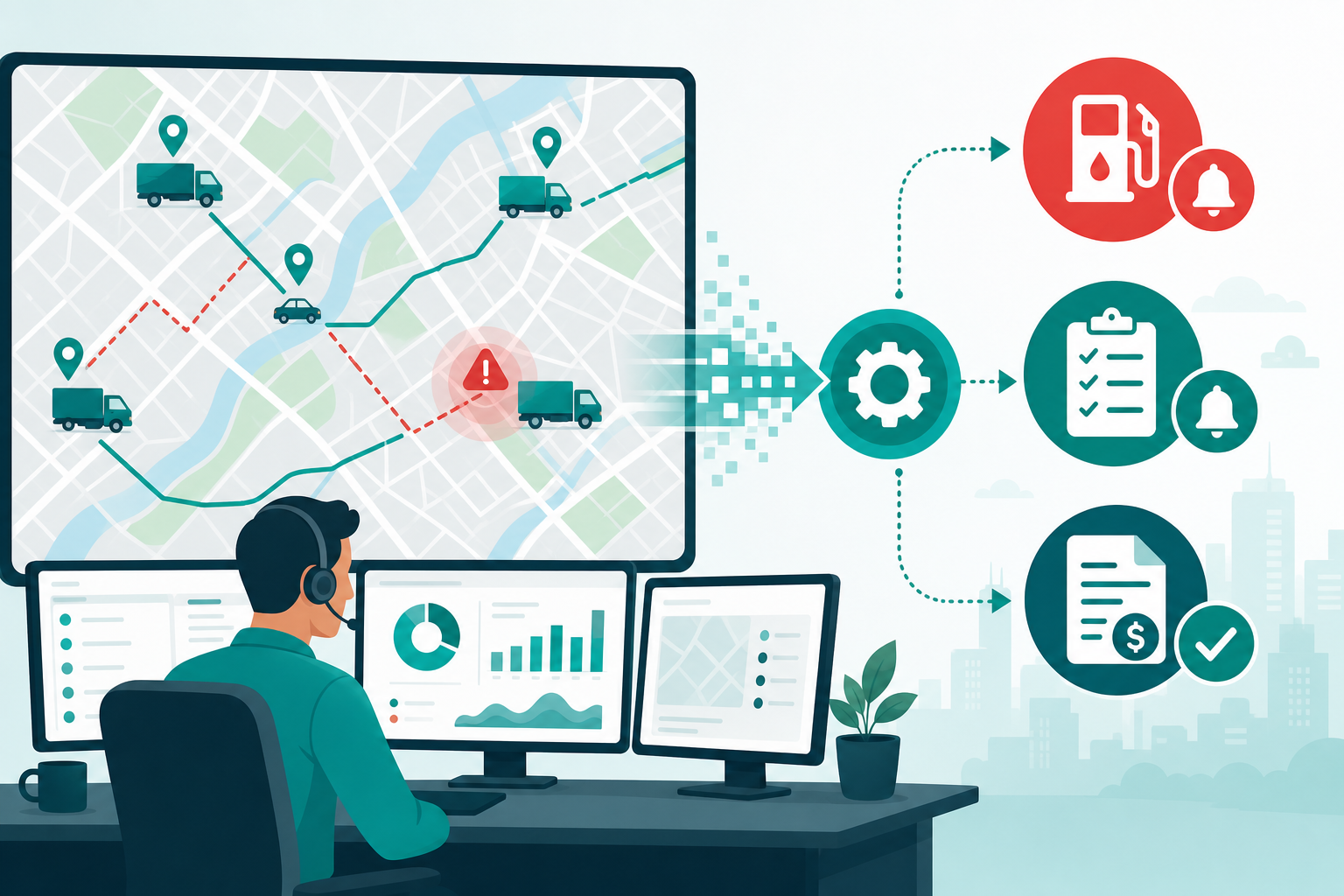
Many Bangladesh fleets pay monthly GPS fees yet run dispatch from phone calls and close billing from manual km — dots on a map nobody acts on. Data creates value only when tied to decisions and workflows: reroute on delay, coach fuel weekly, push client ETA proactively, verify distance at trip close, and replay route for fair incident review.
GPS vendors sell visibility; transport managers need operational integration. Standalone tracking app disconnected from trip desk, fuel module, and billing release reproduces the same disputes with prettier maps.
Shift mindset from surveillance to signals — each alert type should have owner, threshold, and action playbook or disable the alert as noise.
Device offline alerts deserve same discipline as idle alerts — chronic offline may indicate tampering, dead battery, or poor installation. Maintenance contract with GPS vendor should specify offline response SLA. Integrate geofence arrival with client portal only when trip status updates automatically on entry — manual geofence without status change trains clients to ignore portal. Train dispatch on playback tool before incident — first use during crash is learning under pressure.
Assign one operations analyst or senior dispatcher as GPS signal owner — reviews alert configuration monthly, prunes noise, documents action playbooks. Ownerless GPS data becomes expensive map wallpaper.
Dispatch: reroute and client ETA on delay signals
Late loop detected — trigger client ETA message, evaluate backup vehicle rule, adjust second-trip assignment before cascade failure. End-of-day explanation to client after missed window is failure mode; in-transit update is service norm on contract accounts.
- Delay buffer and escalation defined per client tier
- Backup vehicle rule documented for priority lanes
- ETA template sent from dispatch desk not driver personal phone
Fuel and idle: weekly coaching signals
Idle spikes and mileage band breach feed supervisor coaching list — not annual fuel shock. Compare to route class norm; investigate depot idle separately from road idle. Alert fatigue managed by tuning threshold, not disabling measurement.
Client visibility: selective live sharing
Trip link for contract clients reduces status call load measurably — when trip status and location actually update from same system dispatch uses. Broken stale link worse than scheduled phone update; ops discipline required.
Billing: distance band verification at trip close
Compare driver claimed km to GPS band at close — variance above threshold blocks billing release pending reason code. Catches honest rounding errors and systematic inflation before invoice. Band width set per route class to account for urban detour.
Garage and safety: playback for incident and habit review
Route replay supports fair incident analysis and unauthorised stop investigation — not continuous driver watching. Playback request tied to incident ID or approved audit — policy prevents surveillance culture while preserving evidence utility.
Management: branch comparison on movement KPIs
Utilization, idle, on-time departure, and empty return visible branch to branch from movement data — feeds weekly scorecard without retyping. HQ identifies branch needing process support versus branch needing capacity.
GPS integration maturity checklist
Level one: live map. Level two: trip-linked playback. Level three: idle and distance alerts with owners. Level four: client share and billing band at close. Level five: automated ETA triggers. Most fleets stall at level one — assign owner to advance one level per quarter with success metric.
Quarterly GPS data quality review: offline devices, impossible jumps, vehicles without assigned trips — dirty data undermines every downstream decision.
Monthly GPS ops review agenda fixed: top delays acted on, idle outliers coached, billing km disputes from GPS band, offline devices resolved — meeting without agenda becomes vendor complaint session.
Link GPS training certification for new dispatch hires — playback and alert handling before solo shift reduces misuse and alert ignore culture.
Common mistakes to avoid
Buying GPS as compliance checkbox for client RFP without ops workflow — renewal question exposes hollow use. Public driver shaming from playback clips — destroys trust and invites tampering. Another mistake is billing GPS km blindly without route master context — unfair dispute when detour was authorised.
Do not integrate GPS before trip ID discipline — orphan tracks useless for billing proof.
Review GPS ROI semi-annually: count client ETA messages sent, billing km disputes avoided, idle coaching sessions held — if numbers near zero, integration project stalled at map stage and needs executive push.
Quick action checklist
- Each GPS alert type has owner and action playbook
- Delay escalation triggers client ETA on priority accounts
- Weekly fuel and idle outlier list from GPS events
- Distance band check at trip close before billing
- Playback access policy documented for incidents only
- Live share links tested monthly for stale data
- Branch movement KPIs on Monday scorecard
Dispatch screen layout should surface delay and idle alerts adjacent to trip list — alerts in separate unused tab equals no integration regardless of backend capability.
Client success story internal share when GPS ETA prevented penalty — concrete win motivates dispatch to maintain update discipline better than abstract policy memo.
Reward dispatch team quarterly when GPS-driven ETA updates exceed target count — positive incentive sustains client update habit.
Weekly ops lead signs GPS action log — which alerts acted, which dismissed with reason — proves integration not passive tracking.
Integrate GPS delay alert with client notification template — one-click ETA update from alert screen increases actual usage versus separate manual client call.
Connect GPS to trips, fuel, and billing via logistics solutions, explore full platform on Autonemo solutions, or book a demo for integrated control room workflow.