
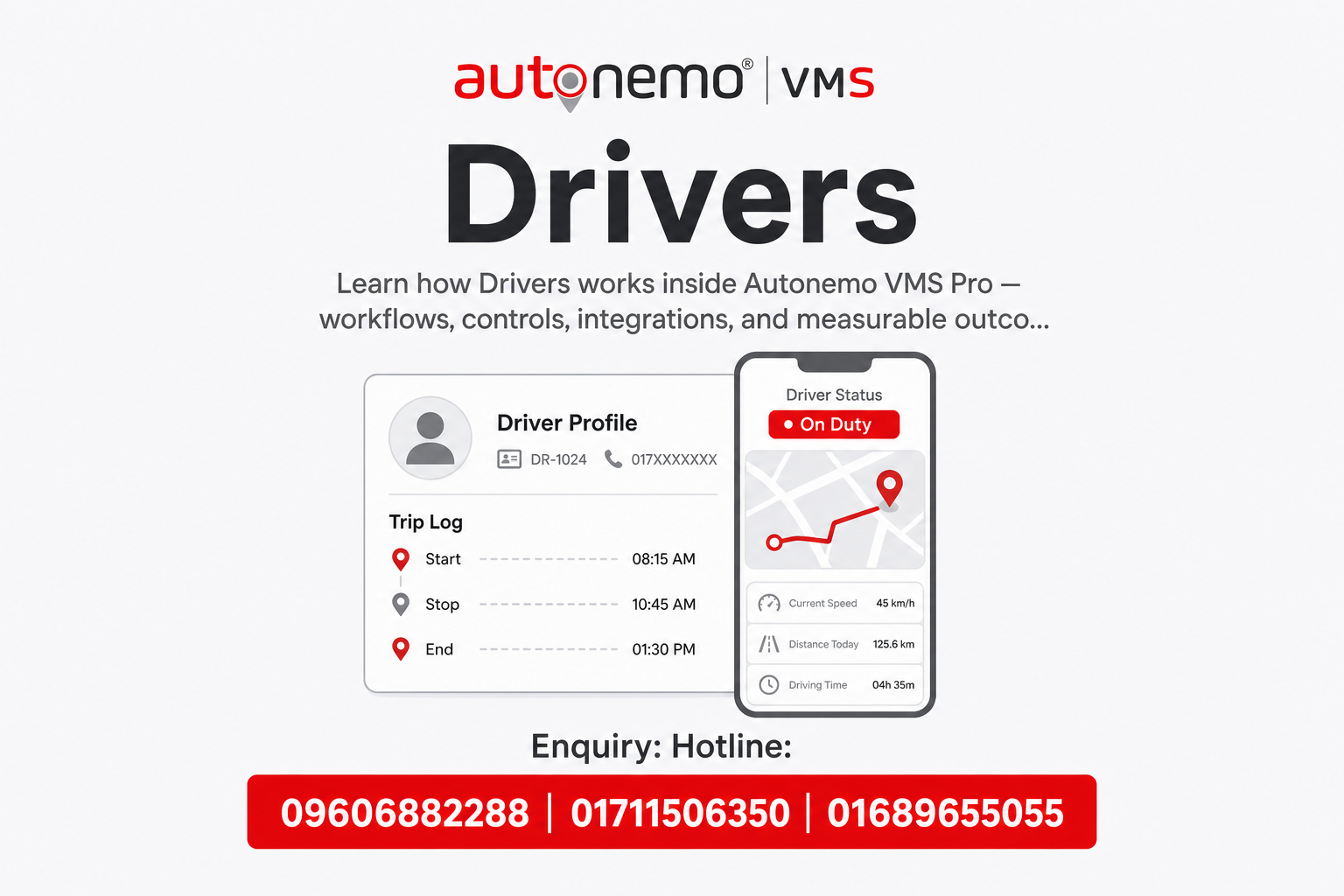
Drivers is part of the connected capability set inside Autonemo VMS Pro — an ERP-style vehicle management platform built for Bangladesh and international transport operators who need more than dots on a map. This guide explains what the capability covers, why it matters on the ground, and how your team can use it with trips, fuel, HR, finance, garage, and reporting in one governed system.
What “Drivers” means in day-to-day fleet operations
In commercial transport, corporate staff movement, logistics, and rental fleet businesses, Drivers is not a standalone spreadsheet column — it is an operational control point. When this control is weak, Driver and helper records that do not connect to trips create payroll disputes, compliance risk, and hidden overtime.
Autonemo treats Drivers inside the broader HR, attendance & payroll layer so dispatch, accounts, compliance, and leadership see the same facts without retyping data between departments.
Why fleets struggle without structured Drivers control
Most operators still mix phone updates, paper registers, and disconnected GPS apps. That creates three predictable failures: delayed decisions, disputed billing, and audits that require heroic manual reconstruction. Workforce data stays tied to the vehicles and trips people actually run.
For multi-branch operators, the pain multiplies because each depot formats data differently. Headquarters then receives reports that look complete but cannot answer simple questions about cost per route, vehicle utilization, or document risk.
How Autonemo VMS Pro delivers Drivers
The platform connects Drivers to live operational context — vehicles, trips, people, money, and documents — rather than listing it as a static menu item. Typical capabilities include:
- Driver and helper master with role-based access
- Attendance, leave, and roster alignment
- Payroll, allowance, and loan tracking
- Driver panel for field self-service
- Provident fund and repeat payroll patterns
- Reports for HR and operations leadership
Role-based access ensures field staff, depot supervisors, and head office each see the right level of detail. Sensitive financial or HR data stays protected while dispatch teams still get real-time operational truth.
Who uses this capability
Primary users include HR teams, depot admins, drivers, helpers, and finance reviewers. In Bangladesh transport culture, clear ownership matters: when everyone assumes someone else updated the register, leakage wins. Autonemo makes the responsible role explicit in workflow and history.
Integration with the rest of the platform
Drivers works best when linked to Trips, fleet assignment, expense claims, and accounts payable. That integration is what separates a vehicle management system (VMS) from GPS-only tracking. Explore the full module map on our solutions hub or the features overview to see adjacent capabilities.
Outcomes leadership can measure
- Faster operational decisions with fewer phone loops
- Stronger audit trail for billing, compliance, and disputes
- Better branch consolidation without manual reformatting
- Earlier detection of leakage, idle time, and document expiry
- Higher trust between operations, HR, and finance teams
Implementation notes for Bangladesh operators
Rollout should start with master data quality — vehicles, drivers, parties, and branches — then activate Drivers workflows with realistic approval rules. Training works best when tied to real trips and real vouchers instead of abstract slides. Most teams schedule a short control-room rehearsal before go-live so supervisors know how to interpret live data.
If you operate mixed fleets (owned, rented, and contractor vehicles), configure ownership and billing rules early so Drivers events post to the correct ledger without month-end rework.
Operational checklist for Drivers
- Confirm branch, vehicle, and role masters are complete before go-live.
- Define who creates, approves, and closes each Drivers record.
- Link Drivers events to trips or vehicles wherever possible — orphan records break reports.
- Set reminder and alert thresholds realistic for your depot culture (not copy-paste from another city).
- Run a two-week parallel period: old register + Autonemo, then cut over when variances are explained.
- Review weekly with operations and finance leads using the same dashboard — not separate spreadsheets.
Common mistakes to avoid
Teams new to VMS software often enable too many screens on day one, which confuses field staff. Start with the minimum viable workflow for Drivers, then expand. Another frequent mistake is skipping branch permissions — every user sees everything, sensitive data leaks, and adoption stalls. Finally, do not treat GPS or reports as a substitute for disciplined data entry at trip start and trip end; the platform amplifies good discipline, it cannot invent missing facts.
Frequently asked questions
Is Drivers available on mobile for field teams?
Field-oriented capabilities such as driver panels, trip proofs, and attendance shortcuts are designed for mobile-friendly access, while head-office controls remain on the full web desk. Exact screens depend on your enabled modules and roles.
Can we enable Drivers without deploying the entire platform at once?
Autonemo is module-based. Many operators start with fleet, trips, and GPS, then expand into fuel, HR, finance, and advanced reporting. Contact our team to sequence modules for your branch count and fleet size.
How does Drivers appear in management reports?
Operational events feed dashboards and exportable reports once transactions are captured with proper branch and vehicle linkage. Leadership can compare branches, vehicles, and time periods without rebuilding spreadsheets.
Next step
See how Drivers fits your fleet on a live walkthrough. Request a demo of Autonemo VMS Pro or browse all platform features to plan module rollout with your operations and finance leads.