
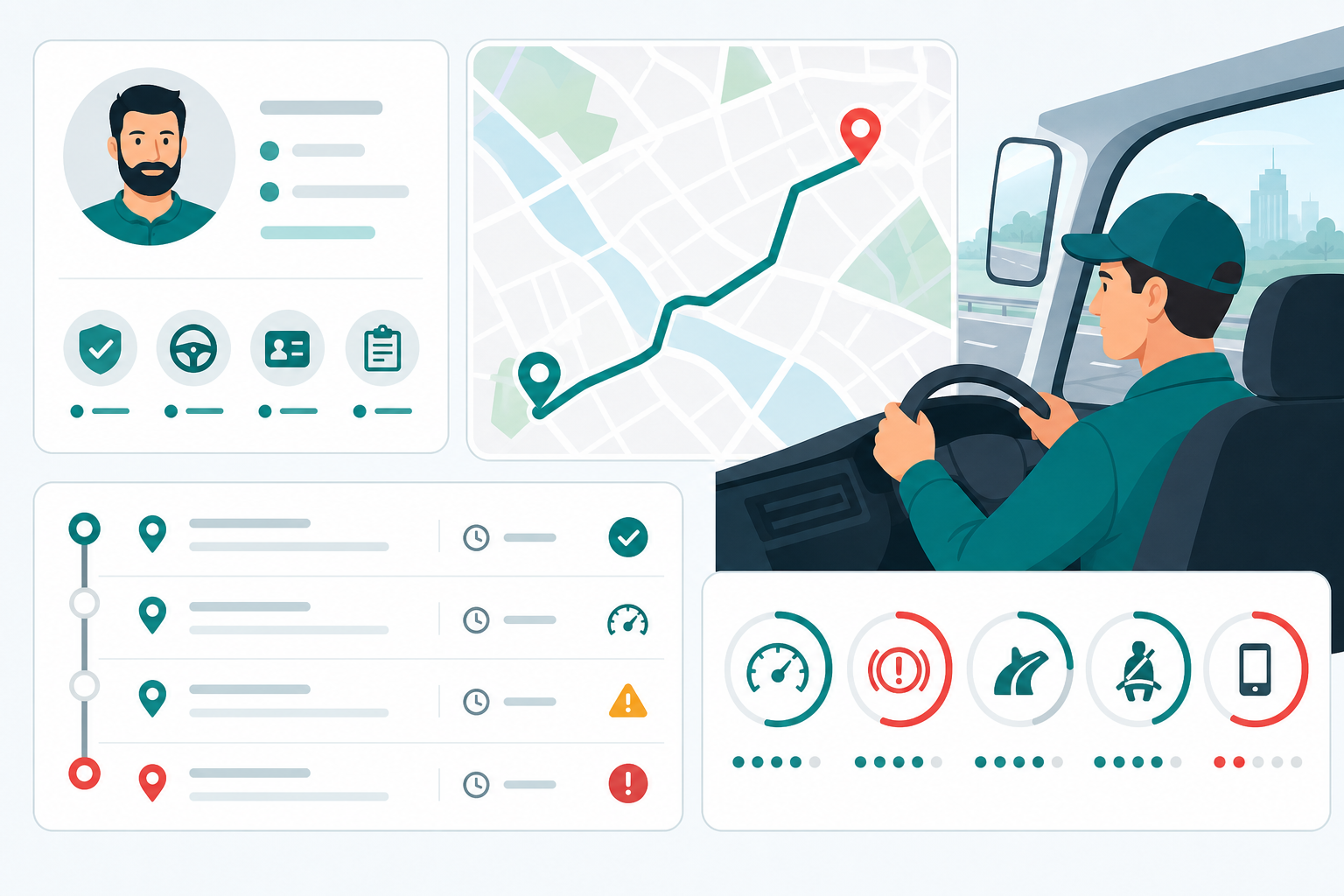
GPS tells you where a vehicle is. Accountability answers whether the job was done correctly, on time, at fair cost, and with documentation that survives client audit. Bangladesh transport culture often equates tracking with control — then wonders why billing disputes and fuel variance persist despite live maps.
Drivers are not the enemy in accountability design. Field teams operate under traffic stress, incomplete loading, and client dock delays operations never sees. Fair measurement pairs location data with trip completion standards, fuel norms, document handoffs, and low-friction incident reporting — so coaching replaces suspicion.
Accountability frameworks fail when metrics are collected but never reviewed, or reviewed only as punishment. The model below gives transport managers measurable levers beyond the dot on the screen.
Union and labour relations in Bangladesh transport vary by depot culture — design accountability as transparent norms applied equally to owned and vendor drivers, with union or staff committee briefed before rollout. Surprises produce resistance; published thresholds and coaching-first response produce adoption. Helpers and cleaners on multi-stop FMCG loops often control document handoff — include them in briefings and checklist training, not only primary drivers.
Start with three metrics only — trip completion, document checklist, fuel band — for ninety days before adding idle and incident layers. Metric overload in month one guarantees supervisor abandonment. When vendor and owned drivers share yard, single visible standard prevents “two tier” resentment that undermines whole programme.
Trip completion aligned to assignment
Assigned trip, planned route, actual path, arrival times, and stop proof should align within agreed tolerances. Deviations without reason codes are management signals — investigate route blockage, client change, or training need before assuming misconduct.
Reason codes must be simple enough for drivers to use at trip end: client not ready, road closure, vehicle issue, authorised reroute. Without codes, playback review becomes accusation.
- Define deviation threshold km or time per route class
- Require reason code before trip close when threshold exceeded
- Review uncoded deviations weekly in supervisor session
Fuel and mileage norms by driver-vehicle pairing
Some variance is route-driven; persistent variance on the same driver-vehicle pair warrants coaching or maintenance review. Compare pairs to route class norm, not to entire fleet hero numbers.
New drivers on complex multi-stop lanes deserve grace period with tighter supervision — accountability without onboarding support drives turnover.
Idle and overnight policy measured, not assumed
Policy only works when measured. Define allowed idle at client yards, loading bays, and regulated waits versus unauthorised depot-side waiting. Overnight rules for long-haul lanes should specify engine-off expectations where safe.
Share team idle averages in briefing; investigate depot spikes before individual confrontation — often idle is systemic delay.
Document and handoff checklist on trip close
Gate passes, delivery notes, return slips, temperature logs where applicable, and seal records missing from closed trips cause billing and compliance gaps. Document status should be as mandatory as km entry — finance cannot release invoice on “trust me, they signed.”
Photograph or scan proof at trip close when clients permit; reduces lost-paper disputes weeks later.
Incident and near-miss reporting without fear
Small scrapes and near-misses unreported become major disputes, insurance complications, and client trust failures later. Low-friction mobile reporting with defined escalation beats surprise audits and WhatsApp rumours.
Reward reporting culture — punishing every near-miss guarantees silence until catastrophe.
Regular coaching cadence tied to data
Monthly one-to-one reviewing trip completion, fuel band, idle, and document scores beats annual disciplinary cycles. Coaching notes should reference specific trips and agreed improvement actions — generic “drive better” messages fail.
Link coaching outcomes to recognition where metrics improve; accountability balanced with acknowledgement sustains field buy-in.
Fair accountability in mixed fleet culture
Vendor drivers must meet same completion and document standards as owned fleet — vendor manager briefed jointly with your dispatch so standards do not feel like arbitrary operator rules. Recognition programme for consecutive weeks inside fuel and document bands costs little and reduces turnover. Disciplinary path exists but follows documented coaching sequence — field teams accept metrics when process is predictable.
Review accountability metrics in union or staff forum quarterly; adjust thresholds if road reality changed — frozen unfair targets destroy programme faster than no programme.
Document accountability programme in employee handbook appendix — drivers and helpers sign acknowledgment once; reduces claim of surprise when coaching follows published norm breach.
Common mistakes to avoid
Using GPS solely for surveillance destroys trust and invites device tampering. Public ranking boards in WhatsApp groups humiliate without improving metrics. Another mistake is holding drivers accountable for client window miss caused by impossible stop sequencing.
Do not ignore helpers and second drivers in accountability model — document handoffs often fail at helper level. Avoid metrics without route context; highway and urban multi-stop cannot share one fuel target.
Transport managers should review accountability dashboard weekly before driver coaching — random coaching without data feels arbitrary. Pair high performers as mentors for new hires on document checklist and trip close; peer learning complements supervisor time.
Quick action checklist
- Publish deviation thresholds and reason codes for trip close
- Review top fuel variance driver-vehicle pairs weekly
- Measure idle against written policy contexts
- Block billing release on incomplete document checklist
- Enable near-miss reporting with defined escalation path
- Schedule monthly coaching sessions with trip-specific examples
- Include vendor drivers in same completion standards as owned fleet
Explore connected driver, trip, and GPS modules across Autonemo industry solutions, or request a demo to see accountability metrics tied to operational workflows rather than standalone tracking.